Low Calorie Foods That Keep You Full Longer
☰ Table of Contents
- 1. Understanding low-calorie foods that keep you full
- 2. Low-calorie foods that keep you full: Evidence and Practical Meaning
- 3. Factors That Change the Answer
- 4. How to Apply This Information
- 5. How to Monitor Progress
- 6. Common Mistakes and Important Limits
- 7. When to Seek Qualified Help
- 8. Sources and Further Reading
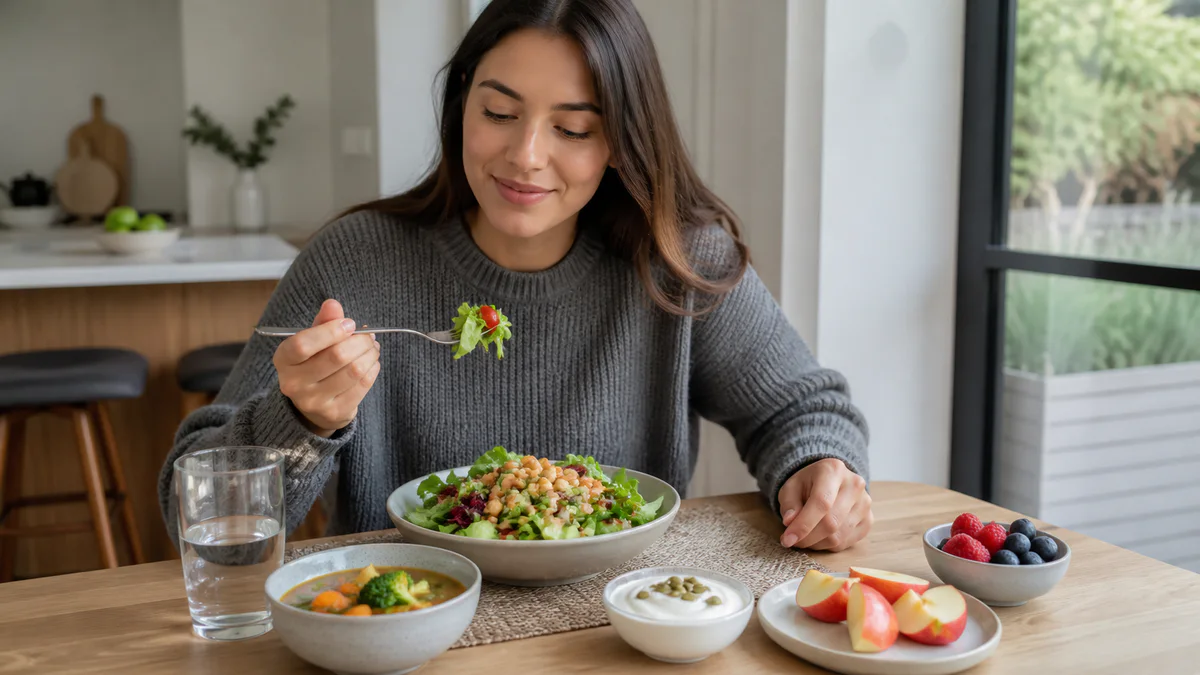
- Vegetables, fruit, broth-based soups, legumes, potatoes, whole grains, lean protein, and lower-fat dairy can provide substantial portions.
- Protein and fibre generally support satiety, while added fats are nutritious but energy-dense.
- A meal made only from very low-calorie foods may leave someone hungry if protein, carbohydrate, or fat is inadequate.
- Add vegetables or fruit to meals you already enjoy.
- Do not classify foods as unlimited because they are low in calories.
Understanding low-calorie foods that keep you full
Foods with water, fibre, protein, or volume can make a calorie target more satisfying, but fullness also depends on taste, meal structure, habits, and the person.
In this article, low-calorie foods that keep you full is used within a wider definition: body weight changes through energy balance over time, but short-term scale movement also reflects water, glycogen, sodium, digestive contents, menstrual changes, illness, and medication.
Vegetables, fruit, broth-based soups, legumes, potatoes, whole grains, lean protein, and lower-fat dairy can provide substantial portions.
Low-calorie foods that keep you full: Evidence and Practical Meaning
The main influence on the answer
Protein and fibre generally support satiety, while added fats are nutritious but energy-dense. This detail changes how low-calorie foods that keep you full should be interpreted and why one person’s experience cannot automatically predict another person’s outcome.
The limit behind the headline
A meal made only from very low-calorie foods may leave someone hungry if protein, carbohydrate, or fat is inadequate. Keep that qualification beside the main claim; leaving it out would make the article sound more certain than the available information allows.
What the facts support
Taken together, these points support a measured approach: add vegetables or fruit to meals you already enjoy. They do not support ignoring the warning to do not classify foods as unlimited because they are low in calories.
Factors That Change the Answer
Personal interpretation of low-calorie foods that keep you full should account for this context: energy needs change with body size, lean mass, age, movement, training, health, medication, environment, and life stage, so calculator outputs are starting estimates.
The individual factors for low-calorie foods that keep you full also include the following: energy needs vary with body size, lean mass, age, occupation, steps, training, sleep, environment, health, medication, and life stage.
Before applying the guidance, identify which of these circumstances are present and whether they alter the starting assumption that vegetables, fruit, broth-based soups, legumes, potatoes, whole grains, lean protein, and lower-fat dairy can provide substantial portions.
How to Apply This Information
1. Establish a reliable starting point
Add vegetables or fruit to meals you already enjoy. This step is designed to address the first key finding: vegetables, fruit, broth-based soups, legumes, potatoes, whole grains, lean protein, and lower-fat dairy can provide substantial portions.
2. Make the next step workable
Include a meaningful protein and fibre source at main meals. Make small adjustments only after a trend is visible; large corrections based on a few days often react to water change rather than tissue change.
3. Review before changing the plan again
Adjust portions based on hunger, energy, and the overall target. Use the review to test whether a meal made only from very low-calorie foods may leave someone hungry if protein, carbohydrate, or fat is inadequate. If the picture is still unclear, improve consistency or allow a more suitable observation period rather than changing several variables at once.
How to Monitor Progress
Progress on low-calorie foods that keep you full should be assessed in this way: track weekly average weight and, when relevant, waist, hunger, energy, training performance, sleep, and adherence.
For low-calorie foods that keep you full, the review should show whether add vegetables or fruit to meals you already enjoy helped without creating the problem described in this caution: do not classify foods as unlimited because they are low in calories.
If progress is unclear, revisit the evidence that protein and fibre generally support satiety, while added fats are nutritious but energy-dense. Then check measurement consistency, changing circumstances, and whether the plan was actually repeatable before making it more restrictive or difficult.
Common Mistakes and Important Limits
Do not overstate what the result proves
Do not classify foods as unlimited because they are low in calories. That limit follows directly from the fact that vegetables, fruit, broth-based soups, legumes, potatoes, whole grains, lean protein, and lower-fat dairy can provide substantial portions.
Avoid a shortcut that creates a new problem
Do not let volume eating replace dietary variety or trigger uncomfortable overeating. A safer approach remains consistent with the practical recommendation to include a meaningful protein and fibre source at main meals.
One further limit applies specifically when using this low-calorie foods that keep you full guidance: it can be useful for learning portions or testing an estimate, but it should not create false precision, moral labels for food, or the belief that nutrient quality no longer matters.
When to Seek Qualified Help
Individual advice about low-calorie foods that keep you full is especially important in these situations: a registered dietitian or clinician can tailor energy targets for pregnancy, adolescence, chronic disease, medication changes, athletic competition, or eating-disorder recovery.
A separate safety boundary also applies to low-calorie foods that keep you full: children, pregnancy, breastfeeding, frailty, diabetes treated with glucose-lowering medicine, chronic disease, and eating-disorder recovery require individual energy guidance.
When asking for individual advice about low-calorie foods that keep you full, bring the relevant measurements, dates, symptoms, medicines, and a record of the attempt to adjust portions based on hunger, energy, and the overall target.
Sources and Further Reading
Ready to get a starting estimate? Try our free Calorie Calculator — instant and no sign-up needed.
Try Free Calculator →Important FAQs About low-calorie foods that keep you full



Calories & Metabolism Quiz
How well do you understand calorie needs, TDEE, BMR, and the science of how your body burns energy?
Take Quiz →Nutrition Knowledge Quiz
How well do you understand macros, vitamins, and healthy eating? Test your nutrition IQ with 10 evid...
Take Quiz →