Healthy Fats vs Unhealthy Fats: The Complete Guide
☰ Table of Contents
- 1. Understanding healthy and less healthy dietary fats
- 2. Healthy and less healthy dietary fats: Evidence and Practical Meaning
- 3. Factors That Change the Answer
- 4. How to Apply This Information
- 5. How to Monitor Progress
- 6. Common Mistakes and Important Limits
- 7. When to Seek Qualified Help
- 8. Sources and Further Reading
- Fat provides essential fatty acids, supports vitamin absorption, and contributes flavour and fullness.
- Replacing saturated fat with unsaturated fat is different from simply adding more fat to the same diet.
- All fats are energy-dense, so portions still matter for an energy goal.
- Use olive or other unsaturated plant oils in place of butter where practical.
- Do not treat “healthy fat” as calorie-free.
Understanding healthy and less healthy dietary fats
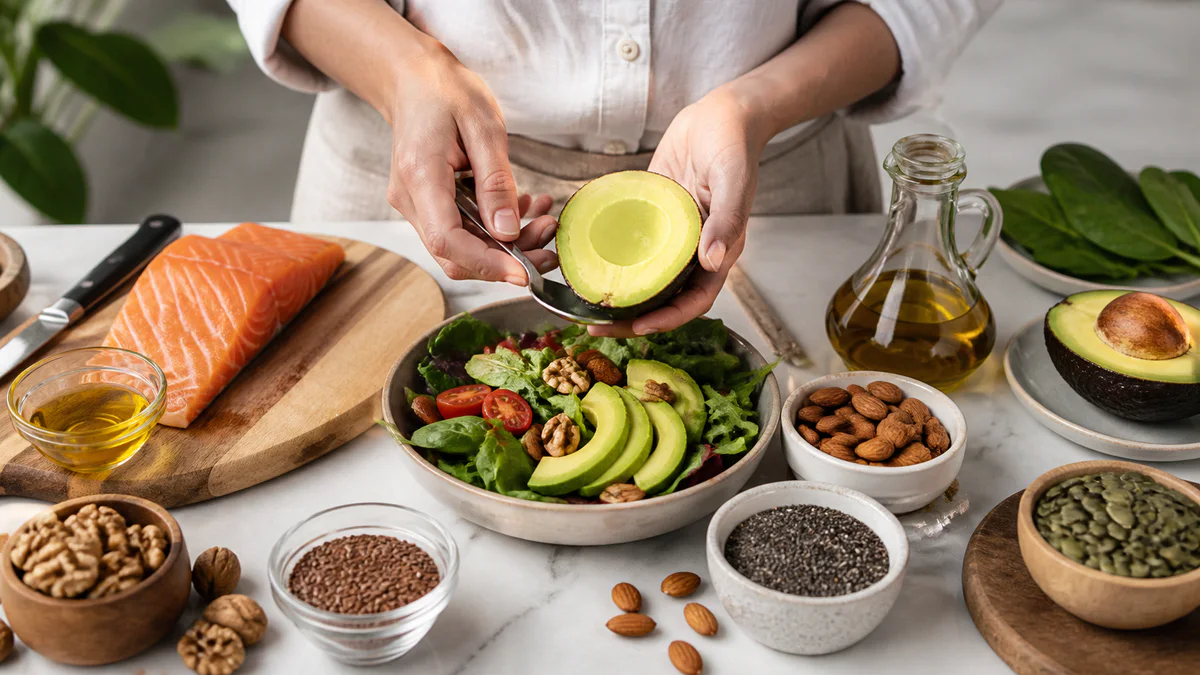
Unsaturated fats from fish, nuts, seeds, avocado, and plant oils generally support a heart-healthy pattern, while saturated and trans fats should be limited in context.
In this article, healthy and less healthy dietary fats is used within a wider definition: each has several roles beyond calories, and food quality, fibre, essential fats, vitamins, minerals, and the overall eating pattern matter alongside any macro target.
Fat provides essential fatty acids, supports vitamin absorption, and contributes flavour and fullness.
Healthy and less healthy dietary fats: Evidence and Practical Meaning
The main influence on the answer
Replacing saturated fat with unsaturated fat is different from simply adding more fat to the same diet. This detail changes how healthy and less healthy dietary fats should be interpreted and why one person’s experience cannot automatically predict another person’s outcome.
The limit behind the headline
All fats are energy-dense, so portions still matter for an energy goal. Keep that qualification beside the main claim; leaving it out would make the article sound more certain than the available information allows.
What the facts support
Taken together, these points support a measured approach: use olive or other unsaturated plant oils in place of butter where practical. They do not support ignoring the warning to do not treat “healthy fat” as calorie-free.
Factors That Change the Answer
Personal interpretation of healthy and less healthy dietary fats should account for this context: nutrient needs vary with total energy intake, body size, activity, age, pregnancy, health, food preferences, and how the whole eating pattern is constructed.
The individual factors for healthy and less healthy dietary fats also include the following: two foods with similar macros can differ substantially in fibre, sodium, micronutrients, processing, portion size, and how filling they are.
Before applying the guidance, identify which of these circumstances are present and whether they alter the starting assumption that fat provides essential fatty acids, supports vitamin absorption, and contributes flavour and fullness.
How to Apply This Information
1. Establish a reliable starting point
Use olive or other unsaturated plant oils in place of butter where practical. This step is designed to address the first key finding: fat provides essential fatty acids, supports vitamin absorption, and contributes flavour and fullness.
2. Make the next step workable
Include fish, nuts, seeds, or avocado in sensible portions. Adjust portions and timing for appetite, training, glucose management, digestive tolerance, and the main goal.
3. Review before changing the plan again
Read labels for saturated fat and partially hydrogenated oils. Use the review to test whether all fats are energy-dense, so portions still matter for an energy goal. If the picture is still unclear, improve consistency or allow a more suitable observation period rather than changing several variables at once.
How to Monitor Progress
Progress on healthy and less healthy dietary fats should be assessed in this way: evaluate hunger, energy, digestion, training performance, food variety, relevant laboratory results, and adherence—not only whether the app reached three exact numbers.
For healthy and less healthy dietary fats, the review should show whether use olive or other unsaturated plant oils in place of butter where practical helped without creating the problem described in this caution: do not treat “healthy fat” as calorie-free.
If progress is unclear, revisit the evidence that replacing saturated fat with unsaturated fat is different from simply adding more fat to the same diet. Then check measurement consistency, changing circumstances, and whether the plan was actually repeatable before making it more restrictive or difficult.
Common Mistakes and Important Limits
Do not overstate what the result proves
Do not treat “healthy fat” as calorie-free. That limit follows directly from the fact that fat provides essential fatty acids, supports vitamin absorption, and contributes flavour and fullness.
Avoid a shortcut that creates a new problem
Do not replace saturated fat mainly with refined starch and added sugar. A safer approach remains consistent with the practical recommendation to include fish, nuts, seeds, or avocado in sensible portions.
One further limit applies specifically when using this healthy and less healthy dietary fats guidance: extreme restriction of an entire macronutrient can reduce food variety and may be inappropriate with pregnancy, growth, diabetes medication, kidney disease, or an eating-disorder history.
When to Seek Qualified Help
Individual advice about healthy and less healthy dietary fats is especially important in these situations: use a registered dietitian for allergies, kidney or liver disease, diabetes medication, pregnancy, restrictive diets, digestive disease, or persistent difficulty meeting needs.
A separate safety boundary also applies to healthy and less healthy dietary fats: use a registered dietitian or clinician for therapeutic diets, allergy, digestive disease, kidney or liver disease, pregnancy, significant deficiency, or medication that can make abrupt carbohydrate or intake changes unsafe.
When asking for individual advice about healthy and less healthy dietary fats, bring the relevant measurements, dates, symptoms, medicines, and a record of the attempt to read labels for saturated fat and partially hydrogenated oils.
Sources and Further Reading
- Dietary Guidelines for Americans
- FDA: How to understand Nutrition Facts labels
- NIH ODS: Omega-3 fatty acids
Ready to get a starting estimate? Try our free Macro Calculator — instant and no sign-up needed.
Try Free Calculator →Important FAQs About healthy and less healthy dietary fats


Nutrition Knowledge Quiz
How well do you understand macros, vitamins, and healthy eating? Test your nutrition IQ with 10 evid...
Take Quiz →Nutrient & Vitamin Deficiency Quiz
Can you identify which deficiency causes which health problem? Test your knowledge of vitamins, mine...
Take Quiz →